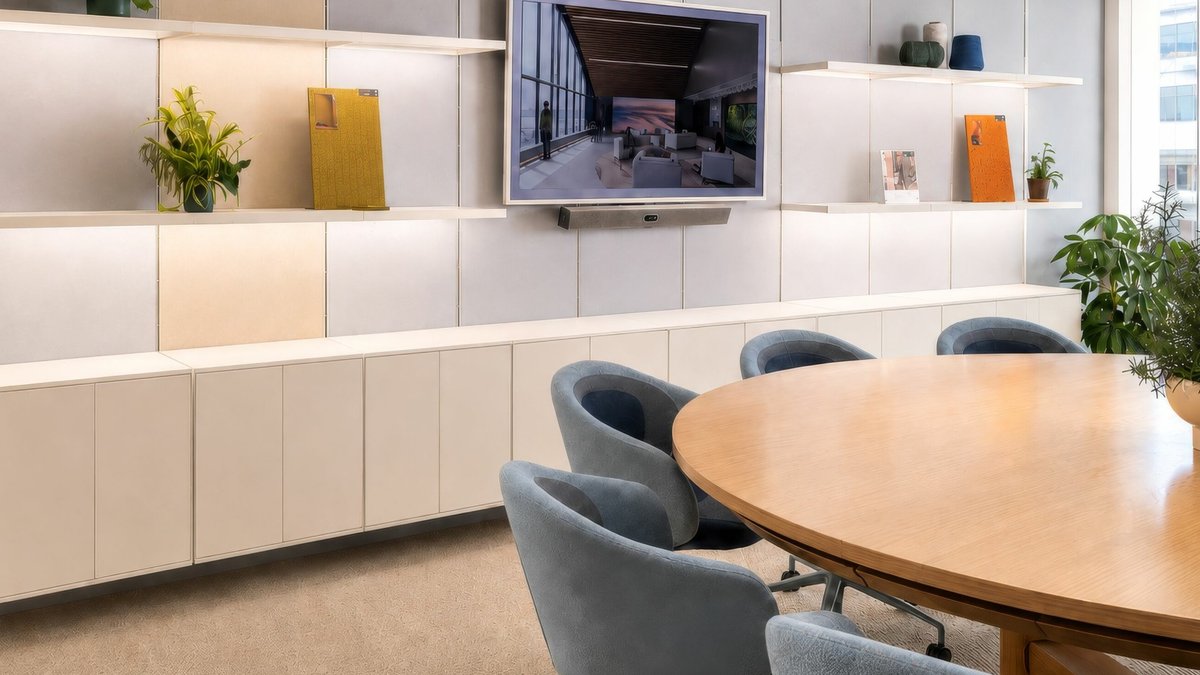
B+N Industries has designed its modular wall systems to evolve after installation, allowing spaces to adapt without tools or major renovations. This adaptability ensures long-term relevance without costly rebuilds.
System 1224: A Grid for Creative Adaptation
System 1224 features a crisp panel grid rooted in Modernist and International Style aesthetics. Its rectilinear profile avoids ornamentation, letting function serve as decoration. Accessories mount from the front, and the grid can shift from strict symmetry to asymmetrical layouts as needs evolve. The system has even been used as a canvas in collaborations, such as with artist Shantell Martin, whose black and white acrylic panels carry her signature drawings, transforming the modular wall into a freestanding display or room divider.
“When the hardware disappears and the materials feel considered, modularity stops feeling like infrastructure and starts feeling like architecture,” she says. The framework supports veneers, metals, acrylics, fabrics, and woods, allowing customization to match specific interior languages. Tool-free reconfiguration means compositions can evolve quarterly without contractors or rebuilding.
Read Also: iF DESIGN AWARD highlights enduring value of rigorous design recognition
Sorbetti 2.0: Tailored Casework for Visible Spaces
Sorbetti 2.0 combines a streamlined aluminum frame with refined casework, offering a warmer, furniture-like aesthetic. Its black anodized aluminum structure provides a graphic line, while the casework nods to mid-century designers like George Nelson and Jean Prouvé. The system is suited for spaces where shelving is meant to be seen, such as lobbies, executive offices, and retail environments.
Shelves and elements adjust in fine increments, with integrated low-voltage power feeds for lighting and signage. When pulled from walls, Sorbetti 2.0 can stand alone as a room divider, concealing storage or displaying items. She adds that the minimalist design ensures it complements rather than competes with surrounding aesthetics, creating a seamless integration into diverse spaces.
Muro: An Open Framework for Diverse Roles
Its open back supports graphics, signage, and SEG light boxes at scale. Power tracks accommodate plug-and-play lighting, while integrated cabinets and digital displays allow mounting, freestanding setups, or floor-to-ceiling installations. One set of parts can front a store, partition a lobby, or organize a healthcare waiting area.
Read Also: Eureka’s Arundel blends walnut and leather for bold, lasting furniture
Designing for Speed and Long-Term Evolution
“Workplace clients are reconfiguring for headcount and hybrid-schedule changes multiple times a year, not once every lease cycle,” she says. Retail and hospitality clients aim to refresh branding and merchandising seasonally without permits. B+N Industries addresses this by designing all three systems to expand from inception, linking product lines through shared grids and maintaining finishes and components in production long enough for future additions.
The company’s approach ensures that a system installed today can incorporate new shelving, lighting, or graphics years later. Shared grids between product lines reduce the need for entirely new infrastructure, while durable materials and finishes withstand repeated reconfiguration. This focus on adaptability reflects a shift in interior design priorities, where flexibility is as critical as initial aesthetics. By prioritizing modular evolution, B+N Industries enables clients to respond swiftly to changing demands without compromising design integrity or operational efficiency.


