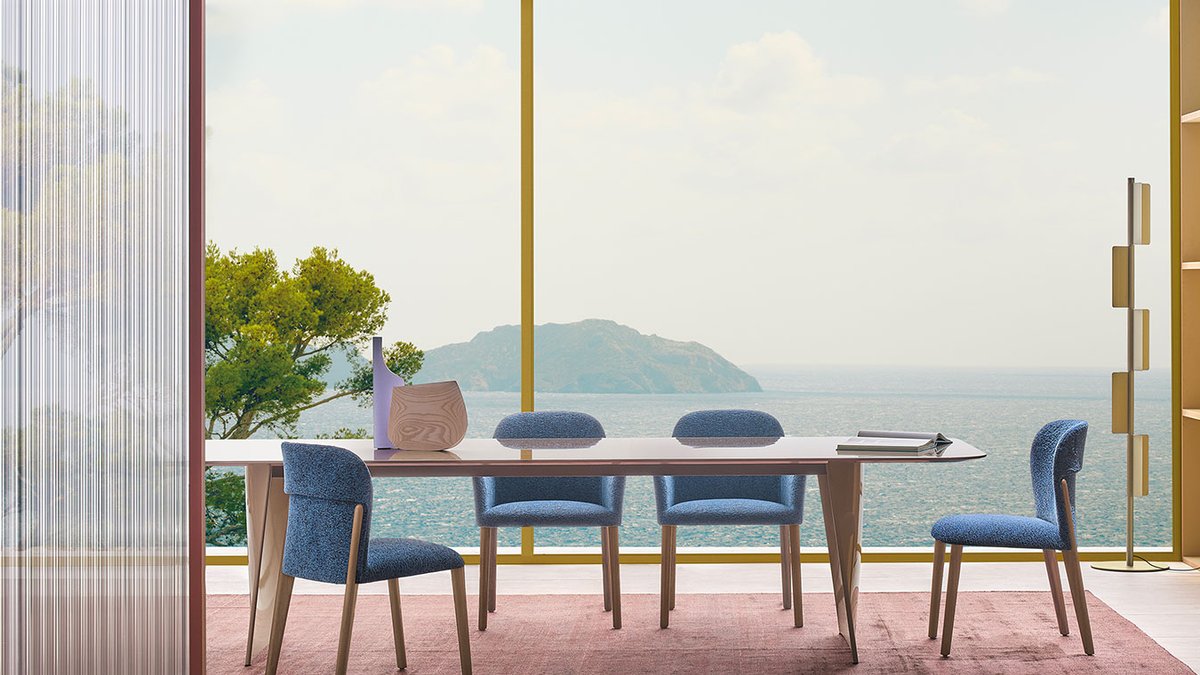
Opale expands its footprint in the hospitality market as Pedrali introduces two new pieces at this year’s Salone del Mobile, completing a line that began with a single armchair designed by Patrick Jouin. The additions aim to blend wood, upholstery and subtle hardware into a unified seating language for restaurants, hotels and lounges.
New Pieces Debuted at Milan’s Furniture Fair
The Milan show featured a chair and a stool that grow out of the original armchair’s silhouette. Both retain the fluid, soft lines that made the first model distinctive, while offering different heights for varied uses. The stool, like its larger counterpart, carries an integrated handle concealed within the backrest, a detail meant to keep the profile clean. The new stool also inherits the solid walnut or ash legs that rise seamlessly into the back, echoing the original armchair’s continuity.
According to the company’s release, the new items are crafted from FSC‑certified walnut or ash, matching the wood used in the armchair. Water‑based coatings, largely derived from plant‑based resins, finish the surfaces, reinforcing the brand’s sustainability stance. The certification guarantees that each board comes from a legally managed forest, and the low‑VOC finish reduces environmental impact. The FSC‑C114358 label and the plant‑derived resin formula are core elements of Pedrali’s long‑term sustainability policy.
Read Also: Homo Faber exhibition showcases five key projects
Design Roots and Material Choices
Jouin’s original armchair combined a solid wooden frame with molded polyurethane foam, creating a seat that feels both sturdy and yielding. The backrest tapers into an oval section that doubles as a handle, allowing staff to pull the chair forward with minimal effort. This gesture, the designer says, reflects the simple act of a waiter inviting a guest to sit. The handle’s smooth curve lets staff glide the chair forward without exertion, reinforcing the welcoming gesture that inspired the design.
The collection’s construction emphasizes durability without sacrificing aesthetic restraint. Elastic webbing is sewn into the seat, providing long‑term comfort even under frequent use. It is carried over to the new chair and stool, ensuring a consistent feel across the range.
In a broader sense, the line mirrors how Italian design often merges craft with modern technology. While the materials are familiar, the way they’re assembled feels fresh, echoing past efforts to make furniture both beautiful and service‑ready. This blend of tradition and tech has become a hallmark of contemporary seating. Pedrali describes this approach as a continuous evolution that responds to how people live and interact with spaces.
Read Also: Can America Build Its Way Out of Socialism
Functionality for Hospitality Spaces
The expanded set lets designers mix seating heights while preserving a coherent visual identity. Restaurants can pair the stool with the chair at a bar, and hotels might place the chair beside a lounge table without clashing styles. This flexibility supports interior schemes that need both variety and unity.
Pedrali’s statement notes that the collection “Born from the meeting of craftsmanship and technology, the collection finds its natural home in the contract and hospitality sectors, and in every environment where beauty must combine with durability without ever becoming intrusive.” The brand continues to rely on local craftsmanship, a practice honed over more than six decades. Its heritage informs every joint and finish, reinforcing confidence among interior architects.
The wood is responsibly sourced.


